Best Ceramic Burr Coffee Grinder: Reviews, Buying Guide and FAQs 2026
by Selmir Omic
Which ceramic burr coffee grinder will actually make your morning cup taste better — and is it worth the upgrade from a basic blade grinder? If you've been grinding your beans at home, you've probably noticed that inconsistent grind size leads to uneven extraction, which gives you coffee that tastes bitter on one day and sour the next. Ceramic conical burrs (the revolving grinding mechanism inside a manual grinder) solve this problem by slicing beans into uniform pieces rather than smashing them randomly. The result is noticeably cleaner, brighter flavor in your cup — whether you're pulling espresso shots or steeping a French press. Our top pick for 2026 is the Handground Precision Manual Coffee Grinder, but depending on your budget and brewing style, any of the seven grinders below could be the right fit for you.
Manual ceramic grinders have surged in popularity over the past few years, and it's easy to understand why. They're quiet, affordable, require no electricity, and produce a grind quality that often rivals electric burr grinders costing three to four times as much. If you're curious how ceramic burr grinders stack up against other types, our best burr grinder guide walks through the full landscape of options. The grinders in this review focus specifically on the ceramic manual segment, covering everything from compact travel mills to large-capacity home grinders. Whether you're a first-time buyer or replacing a worn-out grinder, this guide will help you sort through the options with confidence.
Ceramic burrs have a distinct advantage over steel burrs for manual grinding: they generate less heat during grinding, which means the delicate aromatic compounds in your coffee (the ones responsible for that rich smell when you open a fresh bag) are preserved rather than cooked off. They're also rust-proof and incredibly durable — many ceramic burr sets outlast the grinder body itself. According to Wikipedia's overview of coffee preparation, grind consistency is one of the most critical variables in achieving a balanced extraction. That's exactly what a quality ceramic burr grinder gives you. You can also browse our full collection of coffee equipment reviews to find complementary gear for your setup.

Contents
Standout Models in 2026
- #PreviewProductRating
- Bestseller No. 1
 Rating:

- Bestseller No. 2
 Rating:
 - Bestseller No. 3
 Rating:
 - Bestseller No. 4
 Rating:
 - Bestseller No. 5
 Rating:
 - Bestseller No. 6
 Rating:
 - Bestseller No. 7
 Rating:
Our Hands-On Reviews
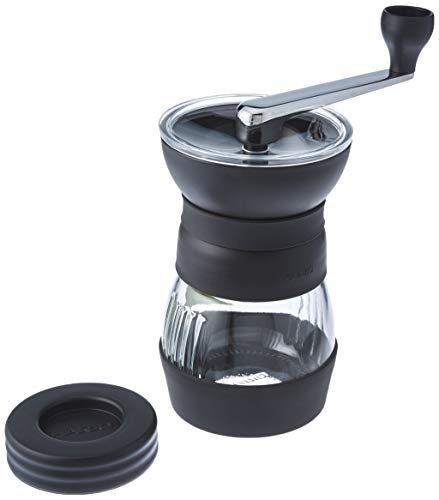
1. Hario "Skerton Pro" Ceramic Coffee Mill — Best Overall for Home and Travel
The Hario Skerton Pro is one of those rare products that has earned genuine loyalty from both casual home brewers and specialty coffee professionals — and after spending time with it, it's easy to see why. Hario redesigned the classic Skerton with cleaner lines, easier burr adjustment, and improved grind consistency across all settings. The ceramic conical burrs sit at the heart of what makes this grinder perform so well: they shave beans cleanly rather than cracking them like a blade grinder would, and they transfer very little heat in the process, protecting the volatile aromatics that make freshly ground coffee so enjoyable. You get a wide range of grind sizes out of this mill, from fine enough for a Moka pot all the way to coarse for a cold brew steep.
In terms of build quality, the Skerton Pro feels solid without being heavy. The glass bean hopper (the upper chamber where whole beans sit before grinding) holds a reasonable amount of coffee for a travel grinder, and the detachable crank handle collapses neatly for packing into a bag. The improved burr adjustment mechanism makes it noticeably easier to dial in your preferred grind size compared to earlier Hario models, where loosening or tightening the burrs required more effort and patience. If you're new to manual grinding, this grinder is forgiving — it doesn't demand precision setup to produce a decent cup, but it rewards you when you take the time to dial it in properly.
Where the Skerton Pro falls slightly short is at very fine espresso-level grinds, where it can produce a small amount of inconsistency compared to grinders with stabilized burr axles. For pour-over, French press, drip, and AeroPress use, however, it performs beautifully. If you're also in the market for a complementary brewing device, our AeroPress guide pairs naturally with this grinder's capabilities.
Pros:
- Wide grind range covering most popular brewing methods
- Ceramic burrs generate minimal heat, preserving coffee flavor
- Compact and travel-friendly with detachable crank handle
- Improved adjustment mechanism over the original Skerton design
Cons:
- Inconsistency increases slightly at very fine espresso-level grinds
- Glass hopper is fragile if dropped during travel
2. Hario "Mini-Slim Plus" Ceramic Coffee Mill — Best for Minimalists and Solo Brewers
If your typical morning involves brewing a single cup or a small AeroPress batch, the Hario Mini-Slim Plus is hard to beat for the price. It's the slimmest grinder in the Hario lineup, with a cylindrical profile that fits in a jacket pocket or a travel pouch without any trouble. Like its bigger sibling the Skerton Pro, this mill uses ceramic conical burrs that produce a clean, consistent grind with minimal heat transfer. Hario upgraded it from the original Mini-Slim with a redesigned ergonomic handle and a better shaft coupling, which gives you noticeably more grip and traction when you're cranking through a full dose of beans.
The Mini-Slim Plus shines for anyone who values portability above all else. It's lightweight, the crank handle detaches for easy storage, and the grind adjustment is simple enough that you can change settings on the go without needing to refer to a manual. For drip coffee, pour-over, and AeroPress, this grinder consistently delivers a uniform particle size that makes a meaningful difference in cup quality compared to a basic blade grinder. The ceramic burrs are also rust-proof, so you can take this grinder camping or to the beach without worrying about moisture damage.
The obvious trade-off here is capacity. The Mini-Slim Plus holds a smaller amount of coffee than most other grinders in this category, which means that if you're brewing for two people or making a large batch of cold brew, you'll need to grind multiple rounds. The grinding effort also adds up quickly for medium-to-coarse grinds, since the smaller burr diameter means more rotations per gram of coffee. But for the solo traveler or the office drawer grinder, it punches well above its price point.
Pros:
- Extremely slim and portable — fits in a pocket or small bag
- Upgraded handle and shaft coupling for better grip and torque
- Ceramic burrs are rust-proof and heat-resistant
- Affordable entry point for quality manual grinding
Cons:
- Small capacity — not practical for brewing more than one or two cups at a time
- More rotations needed per gram compared to larger burr grinders
3. Kyocera Advanced Ceramic Slim Adjustable Coffee Mill — Best for Rust-Proof Durability
Kyocera is better known for its ceramic kitchen knives than for coffee equipment, but this slim grinder draws on the same advanced ceramic engineering that makes those blades famous. The grinding mechanism in this mill is made from Kyocera's proprietary advanced ceramic, which is non-reactive (meaning it won't absorb flavors or odors from previous grinds), completely rust-proof, and extremely hard-wearing. If longevity and material purity are your priorities, this is one of the most thoughtfully built grinders in the manual category. You can grind light roasts and dark roasts back to back without worrying about flavor carryover, which is a real advantage if you like to keep multiple coffee varieties on hand.
The grind adjustment on the Kyocera runs from fine to coarse by tightening or loosening the adjustment mechanism, giving you enough range to cover most popular brewing methods. The non-reactive ceramic grinding surface is a genuine differentiator if you're sensitive to flavor contamination or if you prefer to brew a variety of coffee styles throughout the week. The slim body design makes it comfortable to hold during grinding, and the overall build feels durable enough to last for years of regular use.
Where this grinder is more limited is in the number of distinct, clearly defined grind settings — you adjust by feel rather than by clicking through numbered positions, which can make repeating a precise grind size less reliable. If you're the kind of brewer who likes to carefully dial in your recipe and hit the same grind every morning, you may find the lack of defined click-stops a little frustrating. But if you primarily brew one or two methods and find a grind that works for you, this grinder's durability and non-reactive ceramic make it a compelling long-term investment.
Pros:
- Advanced ceramic is non-reactive — no flavor or odor carryover between grinds
- Completely rust-proof, even with frequent exposure to moisture
- Slim, comfortable grip for extended grinding sessions
- Built to last — Kyocera's ceramic engineering is well established and proven
Cons:
- No defined click-stop settings, making it harder to repeat a precise grind size
- Adjustment by feel requires some trial and error when switching brewing methods
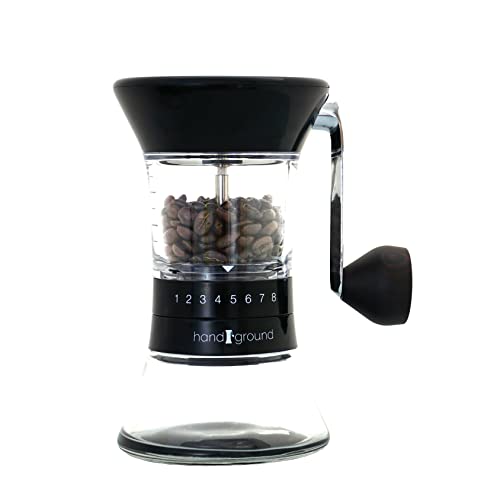
4. Handground Precision Manual Coffee Grinder — Best for Grind Consistency
The Handground was designed differently from most manual grinders on the market — it was built collaboratively with feedback from thousands of coffee enthusiasts, and that community-driven development process shows in the details. The most noticeable difference is the side-mounted crank handle, which sits horizontally rather than on top of the grinder. This ergonomic choice dramatically reduces wobble during grinding, which in turn improves grind consistency, because the burr stays better aligned throughout the grinding cycle. Pair that with a 40mm conical ceramic burr mill and a triple-mounted axle precision-machined to tolerances of 0.004 inches, and you get a grinder that delivers genuinely impressive uniformity across its 15 grind settings.
The 15-position numbered adjustment dial covers a practical range from fine to coarse, giving you clear, repeatable settings for espresso, drip, pour-over, Chemex, cold brew, French press, and AeroPress. The combination of the stabilized axle and the side crank makes Handground one of the most consistent manual grinders you can buy in 2026, especially at mid-range grind sizes where most manual grinders start to show more variability. The body is made from sturdy plastic and stainless steel, and the overall package feels more intentional than most grinders in this price range. If you want to understand why grind uniformity matters so much, our blade vs burr grinder comparison explains the science clearly.
The Handground is slightly larger and heavier than the Hario options, which may matter if you're optimizing for a very minimal travel kit. But if you primarily brew at home and want the most consistent manual grind in this price range, it's hard to argue against what this grinder delivers. The side crank design also means less wrist fatigue during longer grinding sessions — a small thing that becomes meaningful when you're grinding 20+ grams of coffee every morning.
Pros:
- Side-mounted crank dramatically reduces burr wobble for superior grind consistency
- 15 clearly numbered grind settings — easy to repeat your preferred setting daily
- Triple-mounted axle precision-machined to tight tolerances for stable grinding
- Side handle reduces wrist strain during longer grinding sessions
Cons:
- Larger and heavier than compact travel-focused grinders
- Fewer total grind steps than some competitors with 40-click systems
5. Kalita KH-5 Coffee Mill Hand Grinder — Best Traditional Cast Iron Option
The Kalita KH-5 occupies a different space from the other grinders in this roundup — it's a traditional Japanese hand mill with a hard cast iron cutter, and it has a look and feel that leans more toward the classic, antique aesthetic than the modern minimalist designs from Hario or Handground. Kalita is a respected Japanese coffee equipment brand, and the KH-5 reflects the kind of careful manufacturing that has made their products trusted in specialty coffee circles for decades. At 25.2 ounces, it's one of the heavier grinders in this category, and its dimensions (roughly 6.7 x 3.7 x 8.3 inches) give it a sturdy tabletop presence that feels intentional rather than bulky.
The hopper holds up to 1.1 ounces (about 30 grams) of whole beans, and the powder container at the bottom holds up to 2.5 ounces (70 grams) of ground coffee — enough for a generous French press batch or multiple pour-over cups. The cast iron cutting mechanism produces a solid, consistent grind across a wide range of coarseness settings, and the classic design means it will look right at home on a kitchen counter alongside vintage or rustic décor. If you're interested in the heritage and history of coffee grinders in this style, our antique coffee grinder guide covers the category in much more detail.
The main trade-off with the KH-5 is its weight and size — this is not a grinder you're going to toss in a daypack for a camping trip. It's a home grinder through and through, and its cast iron cutter, while durable, requires more careful maintenance than a ceramic burr to prevent rust over time if it gets wet. For buyers who value the feel of a traditional hand mill and want something that will anchor a counter setup rather than travel with them, the KH-5 is a satisfying and well-made choice.
Pros:
- Solid cast iron cutter with a durable, traditional build quality
- Larger capacity hopper and powder container than most portable grinders
- Classic aesthetic that suits vintage or rustic kitchen setups beautifully
- Trusted Kalita brand with a long track record in specialty coffee
Cons:
- Heavy and large — not suitable for travel or portable use
- Cast iron cutter requires more rust-prevention care than ceramic alternatives
6. Rsoilch Manual Coffee Grinder with Ceramic Burr — Best Budget Pick with 40 Settings
If you're looking for a ceramic burr grinder that gives you a wide range of adjustability at a modest price, the Rsoilch manual grinder is worth a close look. It features 40 adjustable grind settings — more than you'll find on many grinders in this price bracket — which means you can dial in different brew styles without jumping between just a handful of broad positions. The conical ceramic burr produces a uniform grind that works well for espresso, drip, pour-over, and French press, covering the full range of what most home brewers actually need on a daily basis.
The design is compact and portable, with a hand crank that makes it practical for camping trips, office use, or travel without adding much weight to your bag. The 40-setting adjustment system is the standout feature here — having that many distinct positions means you can experiment more precisely with your grind size and notice real differences in cup flavor as you fine-tune. The ceramic burr, as with all the grinders in this review, avoids the heat buildup that blade grinders produce, which helps preserve the natural flavor compounds in your beans through the grinding process.
As a newer and less-established brand, Rsoilch doesn't have the same track record as Hario, Kyocera, or Kalita, so you're making more of a leap of faith on long-term durability. For the price, though, the grind output is solid, and the wide adjustment range gives you genuine flexibility. If you're new to manual grinding and want to explore without a large upfront investment, this is a reasonable starting point that won't hold you back from getting quality results.
Pros:
- 40 grind settings offer more precision than most grinders at this price point
- Compact and portable — easy to pack for travel or camping
- Ceramic burr delivers uniform grind with minimal heat transfer
- Budget-friendly entry into the ceramic burr category
Cons:
- Newer brand with a limited long-term durability track record
- Build materials feel less premium than established competitors
7. World's First 60g Large Capacity Manual Coffee Grinder — Best for High-Volume Brewing
Most manual coffee grinders are designed with the solo or dual-cup brewer in mind, which means their capacity tops out at around 25 to 35 grams of whole beans per session. If you're brewing for a family, running a large French press batch, or simply tired of grinding in multiple rounds to get enough coffee for your morning, this 60-gram capacity grinder addresses that frustration head-on. By holding twice the beans of a standard manual grinder, it lets you complete a full grinding session in one go — which is a genuine quality-of-life improvement if high-volume brewing is part of your daily routine. The manufacturer claims this is the world's first manual grinder in this capacity class, and while that's a bold marketing claim, the 60g spec is meaningfully larger than anything else in this roundup.
The external 40-click adjustment ring makes switching between grind sizes simple and intuitive — you can go from an espresso grind to a coarse French press setting in seconds without tools or guesswork. Each click adjusts the burr gap by 0.05mm (millimeters), which the manufacturer notes is the finest difference detectable by professional tasters. Whether you'll actually notice that level of precision in a blind taste test is debatable, but the tight tolerance engineering does translate to noticeably consistent particle size in the grind output. The ceramic conical burr keeps heat low throughout the process, so even a full 60-gram grind session won't cook off your coffee's aromatics.
The trade-off for all that capacity is that the grinder is larger and heavier than the compact travel options in this list, and grinding 60 grams by hand does require some arm effort — especially for finer grind settings that generate more resistance. But if you've been splitting your grinding into two sessions with a smaller grinder and wishing there was a better way, this grinder gives you a practical and well-engineered solution. If you want to put that large grind to work in the best possible way, our best grinder for French press guide covers the full range of options for coarse brewing methods.
Pros:
- 60g capacity — double the typical manual grinder, ideal for families or large batches
- External 40-click adjustment ring is fast and intuitive to dial in
- 0.05mm per click precision for fine-tuned grind control
- Ceramic conical burr keeps heat low even during full-capacity sessions
Cons:
- Larger and heavier than compact travel grinders — less portable
- Grinding 60g by hand requires meaningful physical effort, especially for fine settings
How to Pick the Best Ceramic Burr Coffee Grinder
Burr Size and Grind Consistency
The size of the ceramic burr inside a manual grinder has a direct relationship to grind consistency and grinding effort. Larger burrs — like the 40mm burr in the Handground — grind more efficiently per revolution, which means fewer cranks per dose and a more even particle size distribution. Smaller burrs, like those in the Mini-Slim Plus, require more rotations per gram but keep the grinder body compact. If grind consistency is your top priority, look for grinders with larger burr diameters and stabilized axle systems, which reduce burr wobble during grinding. For casual home brewers who aren't obsessing over extraction precision, a smaller burr will still produce dramatically better results than any blade grinder.
Grind Range and Adjustment System
Different brewing methods call for very different grind sizes — espresso needs an extremely fine grind, while French press and cold brew need a coarse one — and the adjustment system on your grinder determines how easily you can move between them. Numbered click-stop systems like the Handground's 15 settings or the Rsoilch's 40 settings make it easy to record and repeat a specific grind size without guesswork. Stepless systems (which adjust smoothly rather than in clicks) offer infinite positions but require more experimentation to land on a consistent setting. For home brewers who switch between methods regularly, a clearly numbered click system is much more convenient in everyday use. If you want to learn more about how grind settings interact with your brewing method, check out our detailed guide on the best conical burr grinders for deeper technical context.
Capacity and Intended Use
If you're making a single cup every morning, a compact grinder like the Hario Mini-Slim Plus or the Kyocera Slim is perfectly sized for your needs and easy to store. If you regularly brew for two or more people, or if you use a full-immersion method like French press that demands a larger coffee dose, a grinder with more hopper capacity — like the 60g large-capacity option — will save you the frustration of grinding in multiple rounds. Think honestly about how much coffee you actually grind on a typical morning, and pick a capacity that handles it in one session without leaving your arm exhausted.
Portability vs Home Use
Some of these grinders are engineered for travel, with detachable crank handles and compact dimensions that slip into a bag or suitcase without much thought. Others, like the Kalita KH-5, are clearly designed as tabletop home mills that prioritize build quality and capacity over packability. Before buying, be honest with yourself about how you'll actually use the grinder most of the time — a grinder that lives on your kitchen counter has different requirements than one that's going on a camping trip or into a work bag. Most of the Hario options split the difference well, functioning comfortably in both roles, while the Handground and Kalita lean more toward dedicated home use.
FAQs
Are ceramic burr grinders better than steel burr grinders for manual use?
For manual grinding specifically, ceramic burrs have some practical advantages over steel. They generate less heat during grinding, which helps preserve the aromatic oils in your coffee beans. They're also rust-proof, which matters if you grind in a humid environment or travel with your grinder. Steel burrs can be sharper and may last longer in high-volume electric grinder applications, but for manual home use, ceramic is generally the better choice in terms of flavor preservation and maintenance simplicity.
How many grind settings do I actually need?
It depends on how many brewing methods you use. If you primarily brew one method — say, pour-over or French press — a grinder with 10 to 15 settings gives you more than enough range to dial in your preferred coarseness and experiment a little. If you switch between espresso, drip, and coarse methods regularly, a 40-setting system gives you finer control and makes it easier to hit your target without overshooting. More settings aren't always better if you only ever use a handful of them, but having more room to experiment is never a disadvantage.
Can I use a manual ceramic burr grinder for espresso?
Yes, but with some caveats. Most manual ceramic grinders can reach a grind fine enough for espresso, but producing a truly consistent espresso-level grind requires a very stable burr system with minimal wobble — something that higher-end manual grinders like the Handground handle better than basic compact mills. If espresso is your primary brewing method in 2026, you'll get the best results from a grinder with a larger, well-stabilized burr and tight manufacturing tolerances. For occasional espresso alongside other brewing methods, most of the grinders in this review will produce acceptable results.
How long does it take to grind coffee with a manual grinder?
For a single cup dose of around 15 to 20 grams, most manual ceramic grinders take between 60 and 90 seconds of steady cranking at a medium grind size. Finer grinds take longer because the burrs meet more resistance, and larger doses obviously extend grinding time proportionally. A grinder with a larger burr diameter, like the Handground with its 40mm burr, tends to grind more efficiently per revolution than a smaller burr grinder, which reduces overall grinding time for the same dose. It's a meditative ritual for some people and an inconvenience for others — your tolerance for the process matters.
How do I clean a ceramic burr coffee grinder?
Most ceramic burr grinders can be disassembled by unscrewing the adjustment knob and removing the upper burr. Once apart, you can use a small brush (many grinders include one) to sweep out old coffee grounds from the burr chambers and the collection container. Avoid washing the ceramic burrs with water unless the manufacturer specifically says it's safe, as moisture can degrade some grinder components over time. A dry brush-out after every few uses keeps the burrs performing well and prevents stale grounds from mixing with fresh ones and muddying your coffee's flavor.
Is a manual ceramic burr grinder worth it compared to a cheap electric blade grinder?
In almost every case, yes. A quality manual ceramic burr grinder in the $30 to $80 price range will produce a more consistent, more uniform grind than a blade grinder at any price — and grind consistency is one of the most impactful variables in how your final cup tastes. Blade grinders chop beans randomly, producing a mix of fine powder and large chunks that extract at very different rates and lead to an unbalanced, often bitter or sour cup. If you care at all about the quality of the coffee you drink, switching to a ceramic burr grinder — even a basic manual one — is one of the most noticeable improvements you can make to your home brewing setup.
Buy on Walmart
- Hario "Skerton Pro" Ceramic Coffee Mill — Walmart Link
- Hario "Mini-Slim Plus" Ceramic Coffee Mill — Walmart Link
- Kyocera Advanced Ceramic Slim Adjustable Coffee Mill, Black, — Walmart Link
- Handground Precision Manual Coffee Grinder: Conical Ceramic — Walmart Link
- Kalita KH-5 Coffee mill Hand Grinder — Walmart Link
- Rsoilch Manual Coffee Grinder With Ceramics Burr For Espress — Walmart Link
- World's First 60g Large Capacity Manual Coffee Grinder, Port — Walmart Link
Buy on eBay
- Hario "Skerton Pro" Ceramic Coffee Mill — eBay Link
- Hario "Mini-Slim Plus" Ceramic Coffee Mill — eBay Link
- Kyocera Advanced Ceramic Slim Adjustable Coffee Mill, Black, — eBay Link
- Handground Precision Manual Coffee Grinder: Conical Ceramic — eBay Link
- Kalita KH-5 Coffee mill Hand Grinder — eBay Link
- Rsoilch Manual Coffee Grinder With Ceramics Burr For Espress — eBay Link
- World's First 60g Large Capacity Manual Coffee Grinder, Port — eBay Link
Final Thoughts
Whatever your budget, brewing method, or lifestyle, there's a ceramic burr grinder in this list that fits your needs — and any one of them will meaningfully improve the quality of your daily cup compared to a blade grinder or pre-ground coffee. Take a moment to consider how much coffee you typically brew, whether you need portability or prioritize home performance, and how much grind-setting precision actually matters to your brewing routine, then pick the grinder that checks your boxes and start enjoying fresher, more flavorful coffee today.


About Selmir Omic
Selmir Omic is a coffee enthusiast and writer based in San Francisco with a particular interest in specialty coffee culture, single-origin beans, and the relationship between roast level and brewing method. He approaches coffee evaluation from a flavor and origin perspective, covering tasting notes, roast profiles, and the farm-to-cup story behind the beans that serious coffee drinkers seek out. At KnowYourGrinder, he covers coffee bean and roast reviews, taste tests, and guides to specialty coffee for readers building their palate and expanding their brewing knowledge.
Get FREE Coffee Gifts now. Or latest free grinders from our best collections.
Disable Ad block to get all the secrets. Once done, hit any button below