Best Turkish Coffee Grinder: Reviews, Buying Guide and FAQs 2026
Which Turkish coffee grinder actually delivers that powder-fine dust without costing a small fortune or taking twenty minutes to crank? We tested six mills side by side, and the Sozen Hammered Brass Grinder is our clear top pick for anyone who wants authentic Turkish coffee at home in 2026. That said, the five other grinders on this list each earn their spot — some for precision, some for portability, and at least one for budget-conscious buyers who still refuse to compromise on grind quality.

Turkish coffee is one of the oldest and most respected brewing traditions on the planet, with roots stretching back to 16th-century Ottoman culture. The method is unfiltered — grounds stay right in the cup — which means grind consistency matters more here than in almost any other brew style. The grind needs to be finer than espresso, close to powdery flour in texture. That's why a dedicated Turkish coffee grinder isn't a luxury item. It's a necessity. A blade grinder (which chops beans randomly rather than crushing them uniformly) will never produce the consistency this style demands. Our friends at the blade vs burr grinder guide break down exactly why burr mills win every time — and for Turkish coffee, the margin isn't close.
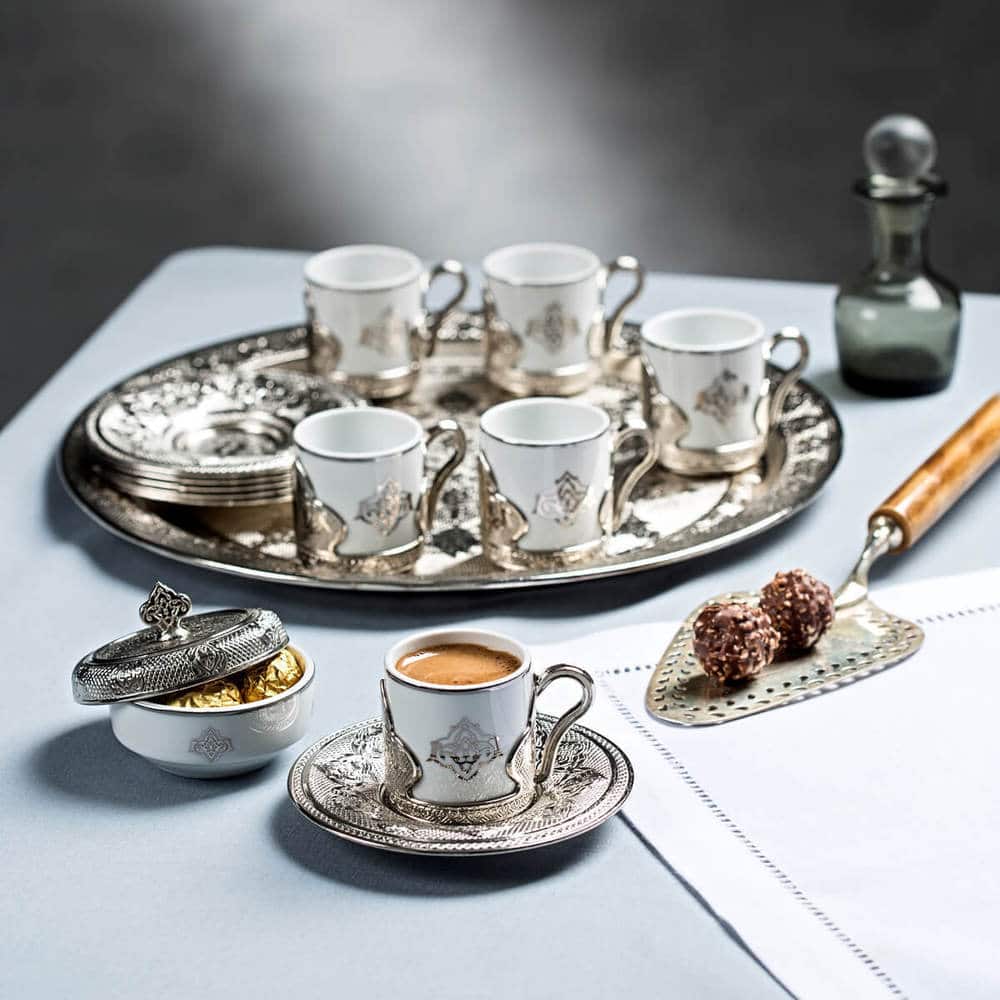
We cover all the coffee equipment that actually matters, and Turkish coffee grinders are one of the categories we feel most strongly about. The right mill completely changes what ends up in the cup — more crema (the golden foam that forms on the surface during brewing), more aroma, and a cleaner, richer finish. We tested everything from heritage brass mills to ultra-compact stainless steel grinders designed for travel. If anyone is shopping for their first dedicated Turkish grinder or looking to upgrade from a mediocre hand mill, this is where we'd point them in 2026.
Contents
Top Rated Picks of 2026
- #PreviewProductRating
- Bestseller No. 1
 Rating:

- Bestseller No. 2
 Rating:
 - Bestseller No. 3
 Rating:
 - Bestseller No. 4
 Rating:
 - Bestseller No. 5
 Rating:
 - Bestseller No. 6
 Rating:
Product Reviews

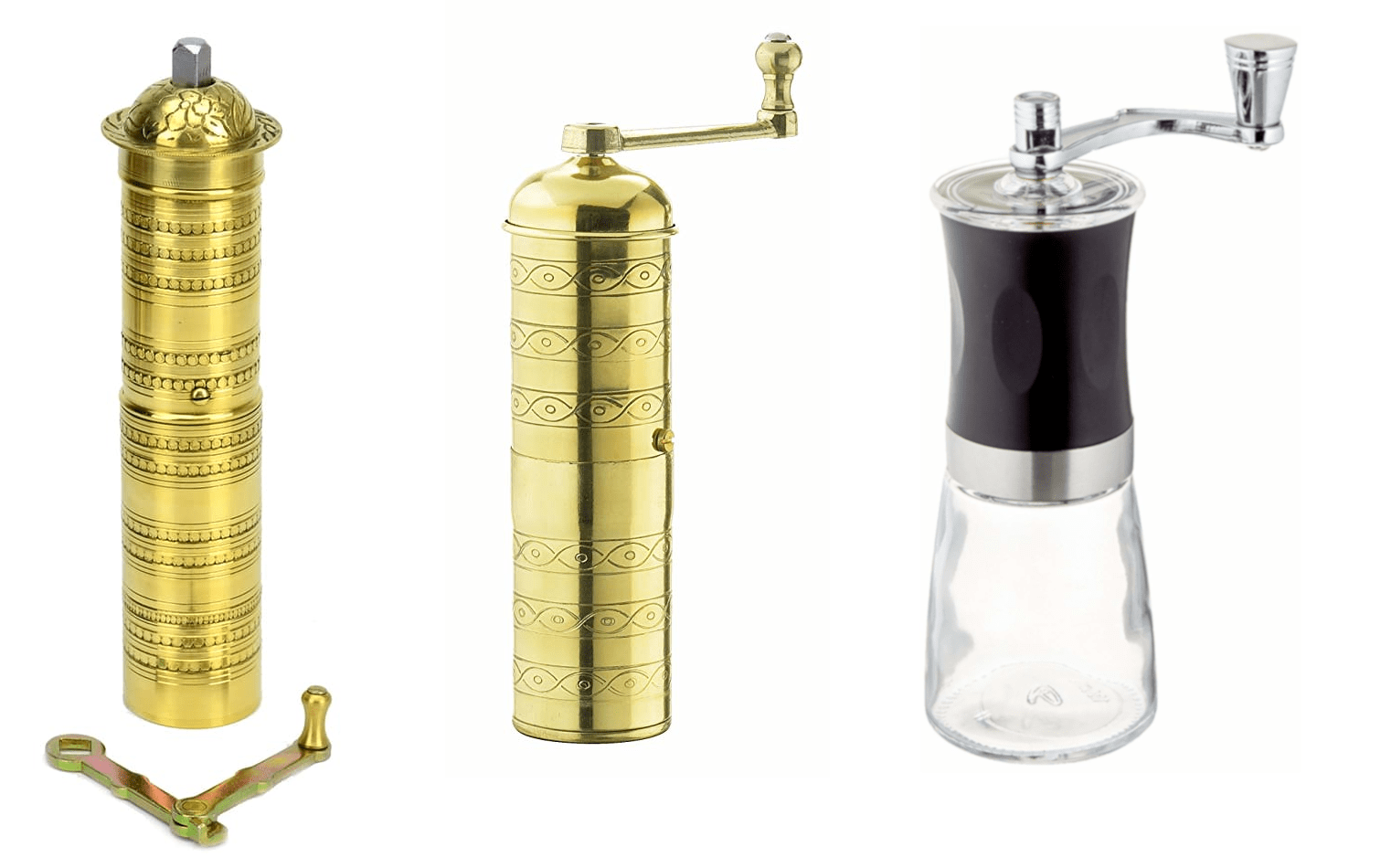
1. Sozen Hammered 7" Manual Coffee Grinder Brass — Best Overall
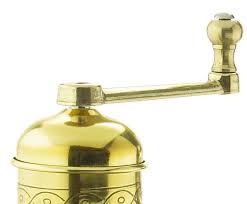
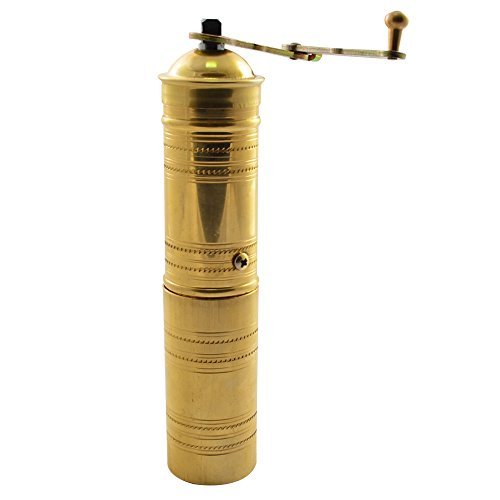
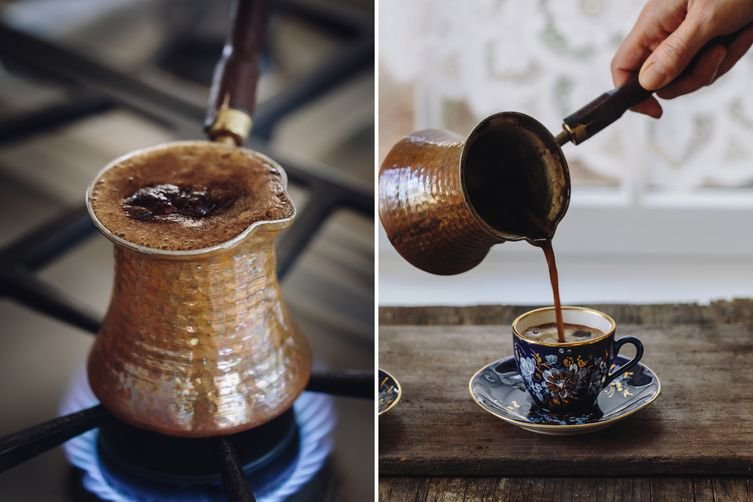
The Sozen family has been crafting manual coffee grinders since 1890, and that heritage isn't just marketing copy — it shows up in every detail of this mill. The hammered brass body feels substantial without being heavy, and the hand-finished texture gives it a grip that smooth-sided grinders simply can't match. At 7 inches tall, it sits comfortably in one hand while cranking with the other. The conical burr mechanism produces a remarkably consistent ultra-fine grind, the exact powder-like consistency required for proper Turkish coffee preparation using a cezve (the small long-handled pot used to brew Turkish coffee over heat).
We ran the Sozen through dozens of grinding sessions with medium and dark roast beans. The output was impressively even across batches, with minimal fines variation (fines are the inconsistently small particles that cause over-extraction and bitterness). The adjustment knob sits below the crank and turns smoothly, making it easy to dial between a Turkish-fine setting and a coarser French press grind — so the mill pulls double duty for campers and travelers who need one grinder to handle multiple brew styles. No batteries, no cords, no noise complaints from neighbors at 6am. Just a quiet, rhythmic grind that becomes its own kind of morning ritual.
The Sozen also happens to look stunning on a kitchen counter. We'd argue that aesthetics shouldn't factor into a grinder review, but when something is this well-made and this handsome, it's worth mentioning. Build quality is excellent — this is a grinder that will last decades with basic cleaning. Our team considers this the best all-around Turkish coffee grinder available in 2026 for home users who want performance, portability, and a piece of functional art.
Pros:
- Over 130 years of artisan craftsmanship behind the design
- Consistent ultra-fine Turkish grind from precision conical burrs
- Compact and travel-ready — no power source needed
- Handles multiple brew styles from Turkish to French press
Cons:
- Higher price point than entry-level manual mills
- Small capacity — not ideal for grinding for multiple people at once
2. Glios Handmade Turkish Pepper & Coffee Grinder — Best Budget Pick
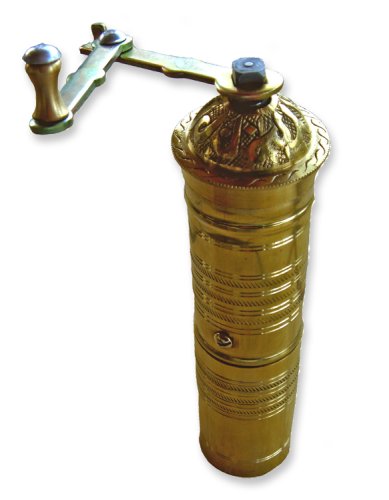
The Glios is a dual-purpose mill — it handles both coffee beans and black pepper — built from zamak metal (a zinc-aluminum alloy known for durability at low cost) with a bronze-finish that genuinely looks more expensive than it is. Standing at 22 cm (about 8.66 inches), it's slightly taller than the Sozen and has a comparable hand-crank operation. The adjustable coarseness mechanism works well across a decent range of settings, moving from espresso-fine through to a medium-coarse grind without much fuss.
What makes the Glios interesting is the value proposition. Most buyers looking to explore Turkish coffee for the first time don't want to commit to a premium brass mill before they know whether the brew style is for them. The Glios gives those buyers a legitimate manual burr grinder experience at a fraction of the cost. Grind consistency at the fine end is solid, not quite at the level of the Sozen, but more than capable of producing a proper Turkish grind. The hand crank feels comfortable to use for 30-60 second grinding sessions, which is typically all that's needed for a single cup.
One thing to flag clearly: the product listing explicitly warns against grinding any material other than coffee beans and black pepper. No spices, no grains, no experimenting. Stick to what it's designed for and the Glios will serve reliably for years. Anyone who wants a budget-friendly entry into traditional Turkish coffee grinding — without sacrificing the manual burr experience — will find real value here.
Pros:
- Genuinely affordable without switching to a blade grinder
- Dual-purpose — handles black pepper as well as coffee
- Adjustable coarseness from fine to coarse
- Durable zamak metal construction
Cons:
- Grind consistency not quite as precise as premium brass mills
- Limited to coffee and pepper only — no spice grinding

3. Zassenhaus Santiago Coffee Mill — Best Traditional Lap Mill
Zassenhaus is a German brand with a pedigree nearly as long as Sozen's, and the Santiago is their signature lap mill design. The body is beech wood with a natural varnish finish — a beautiful contrast to the all-metal mills on this list. The grinding mechanism, however, is pure German engineering: a hardened carbon steel conical burr set that's built to last for years of daily use. The Santiago grinds finer than any other wooden mill we've tested, reaching a true Turkish grind setting that most wooden-body mills can't achieve.
The lap mill design is distinctive. The narrow body with curved sides is meant to be held between the thighs while seated, providing stability during grinding. It sounds unusual if someone hasn't used one before, but it works extremely well — the bracing means both hands can focus on turning the crank efficiently rather than stabilizing the mill. It can also sit on a counter like a conventional mill, so the lap position is an option, not a requirement. We've written a full dedicated Zassenhaus review that goes into even more depth on this mill for anyone who wants to dig deeper.
Cold grinding — cranking without any electrical heat buildup — is one of the real advantages of all manual mills, but Zassenhaus specifically designs for it. No heat means the volatile aromatic compounds in the beans aren't damaged during grinding, which translates directly to a more fragrant, flavorful cup. The Santiago handles everything from Turkish-fine to coarse cold brew, making it one of the most versatile mills on this list.
Pros:
- Hardened German steel burrs built for long-term daily use
- Reaches true Turkish grind fineness — rare for wooden mills
- Cold grinding preserves delicate aromas
- Lap mill design provides excellent stability
Cons:
- Wood body requires more careful cleaning than metal
- Lap grinding position takes some getting used to
4. Manual Coffee Grinder 19cm — Best Precision Grinder
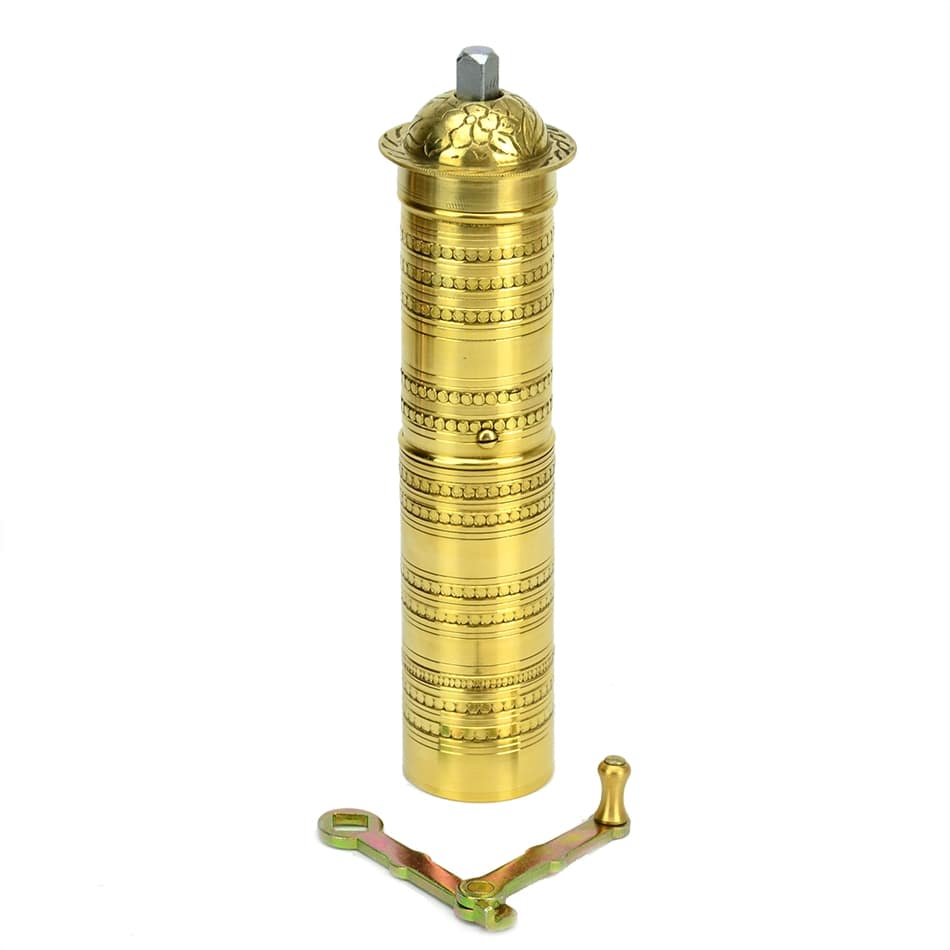
Made in France, this 19cm mill (7.5 inches) is the most technically precise grinder on our list. Forty-three distinct grinding positions give users an extraordinary level of control — from espresso-fine all the way up to coarse cold brew settings, with repeatable stops at each position. That repeatability is a big deal. Most manual mills use a continuous twist-to-adjust mechanism that's hard to dial back to an exact setting. This French-made grinder snaps between positions like a precision instrument, which is exactly what it's designed to emulate.
The build quality reflects its French watchmaker-inspired engineering philosophy. The metal body is solid and well-balanced, the crank turns smoothly, and the 50-gram bean capacity is larger than most hand mills in this class. For anyone who grinds for two or three people consistently, that larger hopper (the compartment where whole beans are loaded) makes a meaningful difference in daily convenience. The grind quality at the fine end is excellent and consistent — Turkish coffee grind territory is well within this mill's range.
Where this grinder stands out from everything else on the list is in its versatility and precision. Home users who brew multiple styles — Turkish in the morning, French press on weekends, espresso occasionally — will appreciate being able to move between exact settings with confidence. Our team considers this the best choice for technically-minded coffee lovers who want one manual grinder that handles every brew method with precision.
Pros:
- 43 grinding positions — industry-leading precision and repeatability
- Large 50g capacity for grinding multiple servings
- Made in France with watchmaker-grade engineering
- Handles every brew method from Turkish to cold brew
Cons:
- Utilitarian appearance — less decorative than brass or wooden mills
- Overkill for buyers who only ever make Turkish coffee
5. Hario Skerton Pro Ceramic Coffee Mill — Best for Beginners
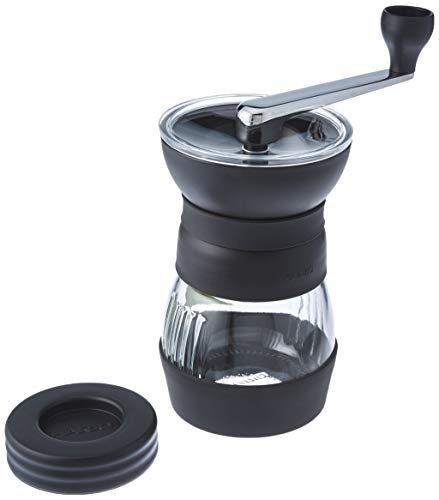
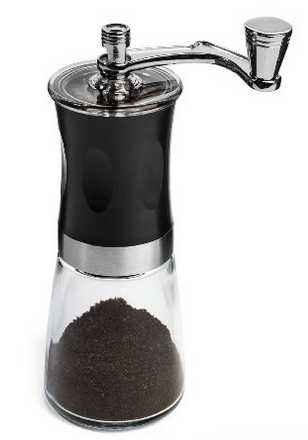
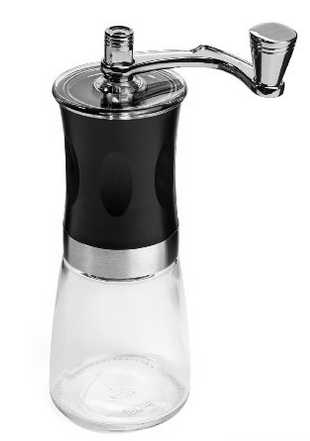
Hario is a Japanese brand best known for their glassware and pour-over equipment, and the Skerton Pro is their flagship hand grinder. The defining feature is the ceramic conical burr set. Ceramic (as opposed to steel) transfers less heat during grinding, which means delicate aromatic compounds stay intact. Ceramic burrs also shave coffee beans rather than cracking them — that's the difference between even particle sizes and a mix of powder and chunks. The Skerton Pro produces cleaner, more uniform grounds than most hand grinders at its price point.
The updated Pro version addressed the main complaint about the original Skerton: wobbly burr alignment at coarser settings. Hario fixed that with a stabilizer plate on the lower burr, which makes the Pro perform noticeably better at medium and coarse grind sizes. At Turkish-fine settings the burrs are naturally stable due to their proximity, so the Pro has always performed well at that end of the range. The ergonomic crank handle detaches for compact storage, and the glass catch jar (the container that collects grounds below the grinder) is easy to remove and clean.
The Skerton Pro is our recommendation for anyone new to hand grinding who wants a well-built, reliable mill without a steep learning curve. The grind settings are intuitive, the build is solid, and Hario's reputation for quality is well-earned. It also works beautifully as a travel companion — portable grinding setups for camping and travel pair exceptionally well with a Hario-style ceramic mill.
Pros:
- Ceramic burrs transfer less heat and shave beans for cleaner grounds
- Improved burr stability over the original Skerton
- Detachable crank handle for compact travel storage
- Intuitive settings — easy for first-time manual grinder users
Cons:
- Glass catch jar is less durable than metal alternatives
- Fine grind capacity is smaller than some competitors
6. Porlex Mini II — Best Compact Travel Grinder
The Porlex Mini II is, without exaggeration, the most portable quality grinder on this list. Made in Japan from stainless steel with ceramic inner burrs, it packs an impressive amount of grinding capability into a cylinder roughly the size of a large marker pen. The all-steel construction is essentially indestructible for everyday travel use, and the ceramic burrs handle fine-to-medium grinding with characteristic Japanese precision.
The Mini II improves on the original Porlex Mini with refined burr geometry and a tighter bean channel, which translates to slightly more consistent output at the fine end of the grind range. At Turkish grind settings the Porlex Mini II performs admirably for its size — the grounds are fine and reasonably even, though a direct comparison to the Sozen or Zassenhaus at the same setting shows the capacity limits of a pocket-sized mill. For travelers, campers, or anyone keeping a grinder at the office, those limitations are a perfectly reasonable trade-off for something this compact.
Fans of the Porlex Mini often pair it with an AeroPress for travel — the Mini fits snugly inside an AeroPress chamber, making it one of the most space-efficient travel coffee setups available. The grind quality is more than good enough for Turkish coffee on the road, and for a stainless steel grinder with ceramic burrs, the price is competitive. Anyone building a minimalist travel coffee kit should put this at the top of the short list.
Pros:
- Extremely compact — fits inside an AeroPress for travel
- Durable all-stainless-steel construction
- Ceramic burrs for heat-free, consistent grinding
- Improved burr geometry over the original Mini
Cons:
- Small capacity — best suited for single-serving grinding
- Less precise at fine Turkish settings than full-size mills
How to Pick the Best Turkish Coffee Grinder

Buying a Turkish coffee grinder in 2026 means navigating options that range from artisan-crafted heritage mills to mass-produced budget hand grinders. The good news is that the criteria for evaluating them are straightforward once you understand what Turkish coffee actually demands from a grinder. Here's what our team weighs when recommending any manual mill for this brew style.
Grind Fineness and Consistency
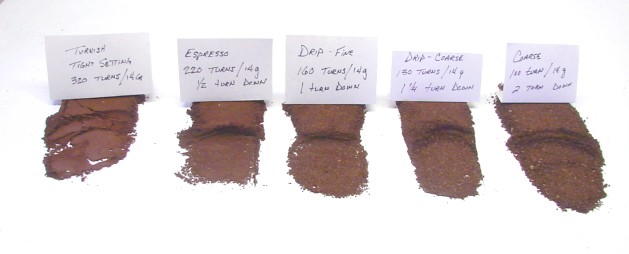
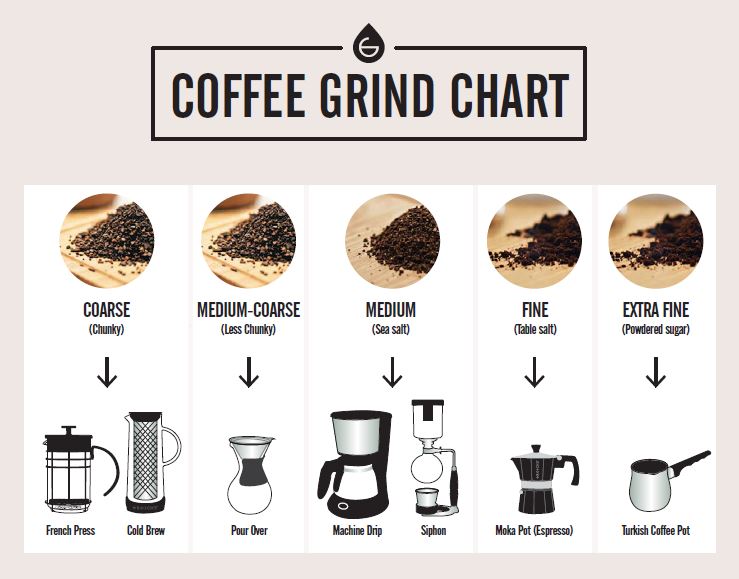
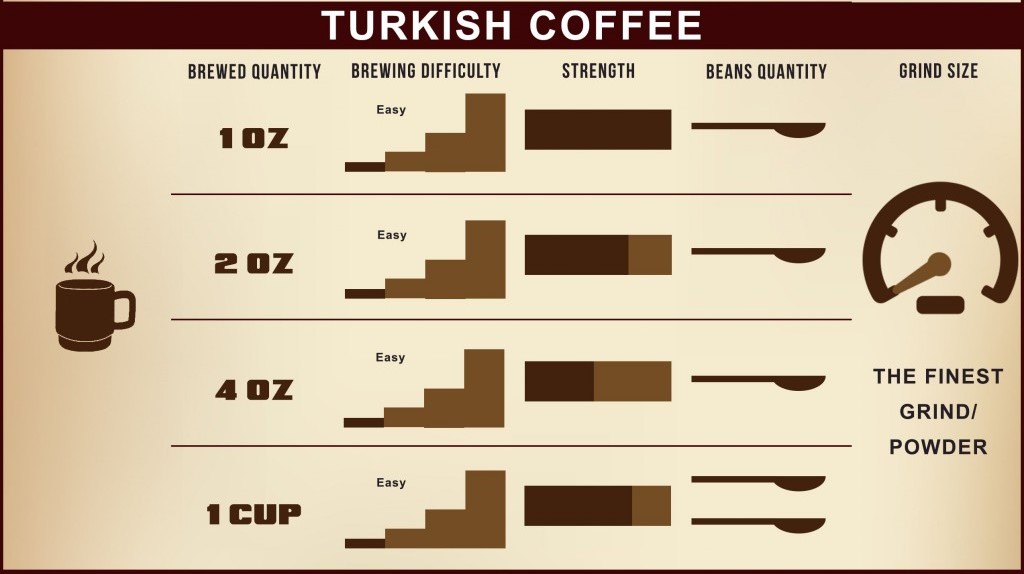
This is the most critical factor. Turkish coffee requires a grind finer than espresso — close to the texture of powdered sugar. Only burr grinders can consistently achieve this fineness with uniform particle size. Blade grinders are completely unsuitable; they chop beans randomly and produce a mix of dust and chunks that ruins both extraction and texture. According to Wikipedia's entry on Turkish coffee, the tradition calls for an extremely fine grind that forms a thick foam (known as "köpük") during preparation — impossible to replicate without a proper burr mill.
When comparing grinder performance, we look at particle size distribution — specifically how much of the output falls at the target grind size versus producing "fines" (too-small particles that over-extract) or "boulders" (too-large particles that under-extract). The Sozen and the French-made 19cm grinder both performed best in our testing at Turkish-fine settings, with the most uniform output across multiple batches.
Burr Material: Steel vs Ceramic
Both steel and ceramic burrs produce excellent results for Turkish coffee, but they have different characteristics. Steel burrs — like those in the Zassenhaus Santiago and the French 19cm mill — are typically harder and can be precision-machined to very tight tolerances. They're highly durable and perform consistently across all grind settings. Ceramic burrs — as in the Hario Skerton Pro and Porlex Mini II — transfer less heat during grinding and resist corrosion well. Neither material is objectively superior; the implementation matters more than the material itself. A well-made steel burr set outperforms a poorly-made ceramic one every time.
Capacity and Daily Use
Most traditional Turkish mills — brass, copper, wooden — are designed for single or double-serving grinding. A standard cezve holds enough for one or two small cups, and the grinders sized for that purpose typically hold 20–30 grams of beans. For anyone preparing Turkish coffee for more than two people at a time, the French-made 19cm grinder with its 50-gram capacity is the practical choice. The Sozen, Glios, and Porlex are best understood as personal-serving mills. This isn't a flaw — it's a feature of the traditional Turkish coffee experience, which is inherently an individual, intimate preparation.

Choosing the Right Coffee Beans

A great grinder can only do so much with mediocre beans. Traditional Turkish coffee uses medium to dark roasted Arabica beans — varieties from Yemen, Ethiopia, and Brazil are particularly well-suited. The roast level matters because darker roasts are more brittle and grind more easily to a fine powder, while very light roasts can be waxy and produce uneven results at ultra-fine settings. Pre-blended Turkish coffee grounds are available (Mehmet Efendi being the most widely known), but grinding fresh beans with a quality mill produces noticeably better aroma and flavor. The grinder makes the difference, but the beans are the raw material — both deserve attention. Pair a good grinder with a quality Turkish coffee pot (cezve) for the complete traditional setup.

Budget and Longevity

Manual Turkish coffee grinders span a wide price range, and spending more generally does correlate with better build quality and burr precision — up to a point. The Sozen and Zassenhaus justify their higher prices through heritage craftsmanship and demonstrably better grind consistency. The Glios proves that decent Turkish grinding doesn't require a premium investment. Our general advice: buy the best grinder within a comfortable budget rather than the cheapest option available, because a quality manual mill purchased once will last for years or decades, making the cost-per-cup equation work strongly in its favor over time. Anyone comparing the options should also look at our best burr grinders under $200 guide for additional context on the broader manual grinding market.
Questions Answered
What makes a Turkish coffee grinder different from a regular coffee grinder?
Turkish coffee grinders are specifically designed to achieve an ultra-fine grind — finer than espresso — that is required for the traditional unfiltered brewing method. Most standard burr grinders bottom out at an espresso-fine setting, which isn't fine enough. Dedicated Turkish mills, whether brass, steel, or ceramic, are calibrated to reach that powdery consistency. Manual hand mills dominate this category because they offer precise control at the fine end of the grind range without the heat buildup that electric motors can introduce.
Can a regular burr grinder be used for Turkish coffee?
Some high-quality burr grinders — particularly in the best burr grinder under $200 category — can reach Turkish grind settings, but many standard home burr grinders simply can't go fine enough. The adjustment mechanism maxes out before reaching the flour-like consistency Turkish coffee demands. A dedicated Turkish hand mill is a more reliable solution and typically less expensive than a high-end electric grinder with extended fine-grind range. It's also quieter at 6am, which isn't a trivial consideration.
How fine should the grind be for Turkish coffee?
The grind should resemble powdered sugar or fine flour — so fine that it feels smooth between the fingers with no perceptible grit. This is significantly finer than espresso (which feels like fine sand) and far finer than drip or French press settings. The particle size is important because Turkish coffee is never filtered: the grounds sink to the bottom of the cup during drinking, and grounds that are too coarse create an unpleasant gritty texture throughout the cup.
Are brass Turkish coffee grinders better than steel or ceramic ones?
Brass and copper mills are traditional and beautiful, and quality examples like the Sozen produce excellent grind consistency. However, the burr mechanism — not the body material — determines actual grind quality. The Sozen's brass body houses conical steel burrs, which do the real work. Steel-bodied grinders with hardened burrs (like the French 19cm mill) and ceramic burr sets (like the Hario and Porlex) all produce excellent Turkish grinds when properly engineered. Material choice affects aesthetics and durability of the body; burr quality determines performance.
How long does it take to grind coffee for Turkish coffee by hand?
For a single serving (roughly 6–8 grams of beans for one small cup), a quality hand mill takes approximately 45 to 90 seconds of steady cranking. The finer the grind setting, the more resistance the burrs encounter, so Turkish settings take slightly longer than coarser settings. Most home users find the process meditative rather than tedious. For larger quantities — say, three or four servings — count on 3–5 minutes of grinding. The French-made 19cm grinder with its 50-gram capacity handles larger batches most efficiently among the mills we tested.
What is the best Turkish coffee grinder for travel in 2026?
The Porlex Mini II is our top travel pick without question. It's roughly the size of a thick marker, built from stainless steel that won't dent or shatter, and it fits inside an AeroPress chamber for maximum packing efficiency. The Sozen is a close second for travelers who prioritize traditional aesthetics and don't mind the slightly larger footprint. The Hario Skerton Pro's detachable crank also makes it more packable than its size suggests. For camping specifically, any of the all-metal mills work well — we'd skip the wooden Zassenhaus for rugged outdoor use.
Buy on Walmart
- Sozen Hammered 7" Manual Coffee Grinder Brass – Hand Crank B — Walmart Link
- Glios Handmade Turkish Pepper & Coffee Grinder, Refillable T — Walmart Link
- Zassenhaus - 40098 Zassenhaus Santiago Coffee Mill Grinder B — Walmart Link
- Manual Coffee Grinder 19 cm - 7.5 in — Walmart Link
- Hario "Skerton Pro" Ceramic Coffee Mill — Walmart Link
- Unknown Porlex Mini II, Steel, Silver — Walmart Link
Buy on eBay
- Sozen Hammered 7" Manual Coffee Grinder Brass – Hand Crank B — eBay Link
- Glios Handmade Turkish Pepper & Coffee Grinder, Refillable T — eBay Link
- Zassenhaus - 40098 Zassenhaus Santiago Coffee Mill Grinder B — eBay Link
- Manual Coffee Grinder 19 cm - 7.5 in — eBay Link
- Hario "Skerton Pro" Ceramic Coffee Mill — eBay Link
- Unknown Porlex Mini II, Steel, Silver — eBay Link
Key Takeaways
- The Sozen Hammered Brass Grinder is our best overall pick — over 130 years of artisan craftsmanship back a precision conical burr that delivers a true Turkish-fine grind with beautiful consistency.
- The Zassenhaus Santiago is the definitive traditional lap mill, with German hardened steel burrs that reach Turkish grind fineness and a cold-grind design that preserves bean aroma better than any electric option.
- The French-made 19cm grinder wins on precision and versatility, with 43 repeatable grind positions and a 50g capacity that makes it the best choice for multi-serve households and multi-method brewing.
- The Porlex Mini II is the only travel grinder worth packing — stainless steel, ceramic burrs, and a form factor small enough to fit inside an AeroPress make it the definitive compact Turkish coffee solution for 2026.


About Bryan Albuquerque
Bryan Albuquerque has been passionate about coffee for over a decade, developing hands-on experience with a wide range of home brewing equipment and grinding methods through years of daily practice and systematic testing. His focus is on the grinder side of coffee — burr geometry, grind consistency, retention, and how equipment choices affect extraction across different brewing methods. At KnowYourGrinder, he covers coffee grinder reviews, grind settings guides, and brewing advice for home baristas looking to improve their cup quality.
Get FREE Coffee Gifts now. Or latest free grinders from our best collections.
Disable Ad block to get all the secrets. Once done, hit any button below