Which espresso machine is actually worth your money in 2026? With dozens of options crowding the market — from sub-$200 entry-level machines to $1,000+ prosumer rigs — picking the right one feels overwhelming. The good news: we've done the heavy lifting for you. If you're in a hurry, the Breville Barista Express BES870XL stands out as a crowd favorite that balances grinder, pressure, and build quality in one package. But it's not right for everyone. Read on to find the machine that fits your skill level, budget, and daily coffee habit.
Espresso is a craft. According to Wikipedia, a proper shot requires water forced through finely-ground coffee at roughly 9 bars of pressure — a process that magnifies every variable, from grind size to water temperature. That's why the machine you choose matters more than it does for drip coffee or a French press. Whether you want a fully automatic push-button setup or a manual machine that rewards practice, there's a right fit for your kitchen. Browse our full espresso guide for deeper background on brewing methods and technique.
In this 2026 roundup, we reviewed seven of the most popular espresso machines available on Amazon — ranging from the beginner-friendly De'Longhi Stilosa all the way up to the professional Breville Dual Boiler. We looked at build quality, ease of use, pressure consistency, steam performance, and long-term value. If you're also shopping for the right grinder to pair with a manual machine, check out our Best Coffee Grinder for Espresso guide before you buy. Now let's get into it.

Contents
Top Rated Picks of 2026
- #PreviewProductRating
- Bestseller No. 1
 Rating:

- Bestseller No. 2
 Rating:
 - Bestseller No. 3
 Rating:
 - Bestseller No. 4
 Rating:
 - Bestseller No. 5
 Rating:
 - Bestseller No. 6
 Rating:
 - Bestseller No. 7
 Rating:
In-Depth Reviews
1. Breville Barista Express Espresso Machine BES870XL — Best All-in-One for Home Baristas
The Breville Barista Express is one of the most recommended home espresso machines year after year — and in 2026, it's still at the top of the conversation. The big selling point is the built-in conical burr grinder that doses directly into the portafilter (the handle-and-basket that holds your grounds). You go from whole beans to a pulled shot in under a minute without a separate grinder taking up counter space. That integration alone sets it apart from most machines in this price range.
The machine uses low-pressure pre-infusion, meaning it starts at a lower pressure before ramping up to the full 9 bars. This gently saturates the coffee puck before full extraction kicks in, which helps pull out flavors evenly and reduces the chance of bitter over-extraction. The thermocoil heating system gets to temperature quickly — about 3 seconds — and the 54mm portafilter with 18–22g dose gives you enough volume for strong, café-quality shots. It's a semi-automatic machine, so you still need to dial in your grind, tamp, and shot time. That learning curve is part of the fun if you enjoy the craft.
Build quality is solid. Brushed stainless steel, sturdy knobs, and a compact footprint. The steam wand does a good job for microfoam once you practice — expect to spend a couple of weeks dialing it in. For anyone serious about home espresso who doesn't want to manage a separate grinder setup, this machine hits the sweet spot.
Pros:
- Integrated precision conical burr grinder — no separate grinder needed
- Low-pressure pre-infusion for even, balanced extraction
- Fast heat-up time (~3 seconds)
- Solid stainless steel construction
- Large 67 oz water tank
Cons:
- Steeper learning curve — requires dialing in grind and tamp
- The built-in grinder, while convenient, isn't as precise as a standalone $200+ burr grinder
- Larger footprint than compact machines
2. De'Longhi Magnifica S Express ECAM23120SB — Best Super-Automatic for Effortless Coffee
If you want espresso without any fuss — no tamping, no dialing, no manual steaming — the De'Longhi Magnifica S is your machine. It's a super-automatic espresso machine, which means it does everything from grinding to brewing with the push of a button. Load the beans, fill the water tank, press a button, and you have espresso. Simple as that. It's a great fit for busy households where multiple people want different drinks fast.
The integrated silent burr grinder is a genuine standout. It runs quieter than most built-in grinders and the 13-setting grind adjustment gives you decent flexibility across different roasts. The machine brews at 15 bars of pump pressure, which is standard for home machines. The hot milk and cappuccino selector lets you choose between steamed or frothed milk, making lattes and cappuccinos accessible even if you've never operated a steam wand. It also saves up to 77% energy thanks to an efficient single boiler system and auto-shutoff.
The trade-off with super-automatics is customization. You can't control extraction the way you can with a semi-automatic. Espresso enthusiasts who love tweaking every variable will find it limiting. But if consistency and convenience are your priorities, the Magnifica S delivers reliably, day after day, year after year.
Pros:
- Fully automatic — grind-to-cup with one button press
- Integrated silent burr grinder with 13 grind settings
- Easy milk frothing with hot milk/cappuccino selector
- Energy-saving design (up to 77% energy savings)
- Very easy to clean with removable brew group
Cons:
- Less control over extraction variables compared to semi-automatic machines
- Not ideal for espresso purists who want to dial in every shot
- Steam performance is functional but not as powerful as manual wands
3. Breville Bambino Plus BES500BSS — Best Compact Machine for Small Kitchens
Counter space is precious. If you're working with a small kitchen but still want a genuinely capable espresso machine, the Breville Bambino Plus is hard to beat. It's compact — significantly smaller than the Barista Express — but it doesn't cut corners on the things that matter most. The 3-second heat-up time is the fastest in its class, powered by ThermoJet heating technology. You're not waiting around. Press the button and the machine is ready almost instantly.
The Bambino Plus uses a 54mm portafilter with 19g dose capacity, which matches the professional standard for single-boiler home machines. Low-pressure pre-infusion is included here too, just like on its bigger sibling. What makes this model "Plus" compared to the base Bambino is the automatic steam wand — it heats and froths milk to your set temperature automatically, which is a big deal if you make lattes and cappuccinos daily. You choose your target milk temperature and texture, and the machine handles the rest. That's a genuinely useful feature at this price point.
Keep in mind: the Bambino Plus doesn't have a built-in grinder. You'll need a separate burr grinder to get the best results. If you want to pair it with a great standalone option, take a look at our Best Burr Grinder reviews to find a good match. Once you have the grinder dialed in, the Bambino Plus punches well above its compact size and price.
Pros:
- Ultra-fast 3-second heat-up via ThermoJet system
- Compact footprint — ideal for small kitchens
- Automatic steam wand with temperature and texture control
- Low-pressure pre-infusion for balanced extraction
- 54mm portafilter — same size as café-standard equipment
Cons:
- No built-in grinder — requires a separate burr grinder
- Smaller water tank (64 oz) compared to full-size machines
- One boiler means you can't steam milk and brew simultaneously
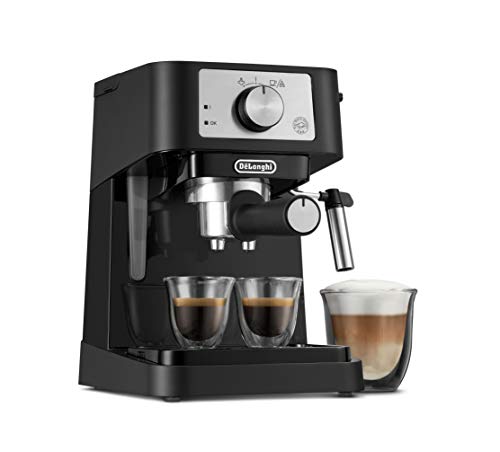
4. De'Longhi Stilosa Manual Espresso Machine — Best Budget Pick for Beginners
Not everyone needs to spend $400 on an espresso machine. If you're just starting out — or you want espresso at home without a big investment — the De'Longhi Stilosa gives you a genuinely functional machine at a budget-friendly price. It runs at 15 bars of pump pressure, which is the standard for home espresso, and includes a manual milk frother steam wand so you can make lattes and cappuccinos without spending more. The stainless steel boiler is built to last, which matters at this price point where many competitors use plastic internals.
The package comes with everything you need to get started: a portafilter, measuring scoop, tamper, and two filters (one for single shot, one for double). Setup is simple and the machine is small enough to fit on most counters without dominating the space. For a first espresso machine, the Stilosa hits the right notes — real pressure, real steam, real espresso, without a complicated learning curve or a high price tag.
What you're giving up is the refinement. Pressure consistency isn't as tight as higher-end machines. Temperature stability can vary between shots. The steam wand requires manual technique and takes some practice to use well. But for the price, you're getting capabilities that would have cost three times as much a decade ago. If you outgrow it, you can upgrade — and you'll already know what you want.
Pros:
- Very affordable entry point into home espresso
- 15 bar pump pressure — genuine espresso extraction
- Manual steam wand for lattes and cappuccinos
- Durable stainless steel boiler
- Includes portafilter, tamper, scoop, and two filters out of the box
Cons:
- Pressure and temperature consistency lower than mid-range machines
- Manual steam wand requires practice to use well
- Plastic exterior may feel less premium
5. Rancilio Silvia Espresso Machine — Best for Serious Home Baristas Who Want to Learn
The Rancilio Silvia has been in continuous production for over two decades. That's not a coincidence — it's because the machine is that good. The Silvia is the machine that taught a generation of home baristas how to pull proper espresso. It's a manual, single-boiler machine with a commercial-grade build that rewards skill and punishes sloppiness — in the best possible way. If you want to actually learn the craft of espresso rather than just push a button, the Silvia is one of the most trusted platforms for doing exactly that.
The 12-ounce brass boiler is a key feature. Brass retains heat better than stainless steel and takes pressure evenly. You do need to temperature-surf (a technique where you time your shots between heating cycles to catch the boiler at the right temperature) or add a PID controller (a temperature regulation device) to get the most out of it — which is an extra cost but significantly improves shot consistency. The steel case is bomber-solid and fits in any kitchen decor without looking out of place.
The Silvia's steam wand is commercial-style — powerful and fast. Once you master it, you can produce café-quality microfoam for latte art. The machine doesn't have a built-in grinder, so pair it with something capable. Our Best Coffee Grinders Under $500 guide has solid options that match the Silvia's level. This is a machine you buy once and keep for years.
Pros:
- Over 20 years of proven reliability — one of the most stable home espresso platforms ever made
- 12-ounce brass boiler for excellent heat retention
- Commercial-style steam wand — powerful and fast
- All-steel exterior construction — built to last decades
- Strong community of users and modification guides (PID, pressure mods)
Cons:
- Single boiler — can't brew and steam at the same time
- Temperature surfing required without a PID controller (sold separately)
- No built-in grinder
- Higher price for a machine that requires more skill to use well
6. De'Longhi Dedica Arte Espresso Machine — Best Slim Design for Style-Conscious Buyers
If your kitchen counter is tight and you care as much about aesthetics as espresso, the De'Longhi Dedica Arte deserves a close look. At just 6 inches wide, it's one of the slimmest home espresso machines on the market. The Italian stainless steel design looks sharp — genuinely nice enough to leave out on your counter without it cluttering the space. But looks aside, it's a capable machine at 15 bars of pump pressure with a 3-level temperature control system (so you can fine-tune extraction to your taste).
The standout feature here is the My LatteArt steam wand. Unlike basic steam wands that just blast steam, this wand is specifically designed to help you achieve the right milk texture for latte art — smooth, glossy microfoam that sits on top of your espresso without sinking. It's a well-thought-out feature for home baristas who want café-quality drinks. The 3-level temperature control means you can adjust brewing temperature to suit lighter or darker roasts, which is a feature you don't usually get in this compact format.
The Dedica Arte is a semi-automatic machine, so you'll need to grind your own coffee separately and tamp it yourself. It's a good middle ground between the fully-automatic Magnifica S and the more demanding Rancilio Silvia — enough control to get good results, but not so demanding that you need to become a barista to enjoy it.
Pros:
- Only 6 inches wide — the slimmest option in this roundup
- Beautiful Italian stainless steel design
- My LatteArt steam wand for café-quality milk texture
- 3-level temperature control for adjusting to different roasts
- 15-bar pump pressure with consistent results
Cons:
- No built-in grinder — separate grinder required
- Smaller water reservoir than full-size machines
- Not ideal for high-volume brewing (single boiler)
7. Breville Dual Boiler Espresso Machine BES920XL — Best Prosumer Machine for Serious Enthusiasts
The Breville Dual Boiler is the top-of-the-line option in this roundup and one of the best prosumer (professional-consumer) espresso machines you can buy for home use in 2026. The defining feature — as the name says — is two separate boilers: one dedicated to brewing, one dedicated to steaming. That means you can pull a shot and steam milk at exactly the same time, with no temperature compromise on either. Single-boiler machines force you to switch modes between brewing and steaming, which slows you down and can affect shot quality.
The BES920XL uses a 58mm portafilter — the same size as most commercial espresso machines — with a 19–22g dose capacity. The Over Pressure Valve (OPV) limits the maximum pump pressure throughout extraction, which prevents the bitter, harsh flavors that can result from excessive pressure. Low-pressure pre-infusion expands the coffee puck gently before full pressure kicks in. Combined, these systems give you extraordinarily even, balanced extractions that rival what a trained barista produces on commercial equipment.
The dual PID (Proportional-Integral-Derivative) temperature control system lets you set both boiler temperatures independently with precision down to 1 degree. You can also program pre-infusion time, shot volume, and water temperature. This is a machine that grows with your skill level. The learning curve is real — it's not a machine you buy to make espresso without thinking. But if you're serious about the craft and want the best results possible from a home machine, the Dual Boiler is hard to beat at its price point. Serve your shots in proper vessels — our Best Espresso Cup reviews can help you find the right ones.
Pros:
- True dual boiler — brew and steam simultaneously with no compromise
- Dual PID temperature control — set each boiler independently to 1-degree precision
- 58mm commercial-standard portafilter
- Over Pressure Valve prevents bitter over-extraction
- Programmable shot volume, pre-infusion time, and water temperature
- Full stainless steel build — premium feel and durability
Cons:
- Highest price in this roundup — significant investment
- Steep learning curve — requires time and practice to dial in
- Large footprint — needs counter space
- No built-in grinder at this price (you'll want a quality standalone)
How to Pick the Best Espresso Machine
Automatic vs. Semi-Automatic vs. Manual
This is the first decision you need to make, and it shapes everything else. Here's how the three types differ:
- Super-automatic: Grinds, doses, tamps, and brews with one button press. Maximum convenience, minimum control. Best for households where multiple people want coffee with no learning curve. The De'Longhi Magnifica S is a good example.
- Semi-automatic: You grind (separately or via built-in grinder), tamp, and the machine controls the pump. Most popular for home baristas. Gives you meaningful control without being overwhelming. Most machines in this roundup are semi-automatic.
- Manual (lever or piston): You control water pressure manually. Maximum control, highest skill ceiling. Rare at consumer price points but worth knowing exists.
For most buyers in 2026, semi-automatic is the sweet spot — enough control to improve your technique, enough automation to make it practical for daily use.
Single Boiler vs. Dual Boiler
The boiler is where water gets heated for both brewing and steaming. Here's what the distinction means for you:
- Single boiler: One heater serves both functions. You brew, then switch to steam mode (or vice versa). Temperature fluctuates between modes. Most home machines are single boiler. Fine for most people.
- Heat exchanger (HX): A single boiler with a tube running through it. Lets you brew and steam at the same time, though temperature management is trickier.
- Dual boiler: Two completely separate boilers — one for brewing, one for steaming — each controlled independently. Best performance, highest cost. The Breville Dual Boiler BES920XL is the example here.
If you make multiple drinks in a row every morning (cortados, lattes, cappuccinos), a dual boiler saves real time and produces better, more consistent results.
Do You Need a Built-In Grinder?
Freshly ground coffee makes a noticeable difference in espresso quality. Pre-ground coffee loses volatile aromatics quickly after grinding — sometimes within minutes. So you have three options:
- Buy a machine with a built-in grinder (like the Barista Express or the Magnifica S) for convenience
- Buy a separate burr grinder to pair with your machine for better grind quality and more control
- Use pre-ground espresso from a specialty roaster as a compromise
Built-in grinders are convenient but usually can't match the grind quality of a dedicated $150–$300 standalone burr grinder. If you want the absolute best shots and have counter space, go separate. If counter space is tight, an all-in-one machine is a sensible trade-off.
What to Look for in Milk Frothing
If you drink lattes, cappuccinos, or flat whites regularly, the steam wand matters as much as the espresso system. Here's what separates a good steam wand from a bad one:
- Boiler size: Larger boilers produce more sustained steam pressure. Better for frothing large pitchers.
- Wand tip design: Single-hole tips are easier for beginners; multi-hole tips produce finer microfoam faster but require more technique.
- Panarello attachment: The plastic sleeve some wands use to automatically introduce air. Good for beginners, less flexible for advanced users.
- Automatic vs. manual: The Bambino Plus has an automatic wand that handles texturing for you. Manual wands give more control once you've practiced.
Don't overlook this — bad steam performance is one of the most common complaints with budget machines.
Questions Answered
What does 15 bar pressure mean on a home espresso machine?
Bar is a unit of pressure. Espresso extraction ideally happens at around 9 bars of pressure at the coffee puck. Many home machines are rated at 15 bars from the pump — the excess pressure is managed by an internal valve (called an OPV, or over pressure valve) that limits what reaches the coffee. So when you see "15 bar" on the box, it means the pump is rated to produce 15 bars, not that 15 bars hits your coffee. Machines with adjustable or pre-set OPVs (like the Breville Dual Boiler) are more precise about what pressure actually reaches the puck.
How long does it take to learn how to pull a good espresso shot?
Most people get decent results within a few weeks of daily practice. The main variables to dial in are grind size, dose (how much coffee you use), and tamp pressure. Expect your first few shots to taste off — too sour (under-extracted) or too bitter (over-extracted). A good rule: adjust one variable at a time, taste, and note the result. Within 20–30 shots, most beginners start pulling something they're genuinely happy with. Super-automatic machines skip this process entirely, which is either a feature or a limitation depending on your perspective.
Is an espresso machine worth it if you drink one shot a day?
It depends on your math. A single espresso at a café averages $3–$5 in most cities. If you drink one a day, that's $90–$150 per month. A mid-range machine like the Breville Bambino Plus pays for itself in 3–5 months of daily use. Beyond that, you're saving money. Factor in the cost of beans (much cheaper per shot than café prices) and the machine gets even more cost-effective over 2–3 years. Short answer: yes, it's almost always worth it if you drink espresso consistently.
What's the difference between a latte and a cappuccino, and does the machine matter?
A latte is espresso plus a larger amount of steamed milk with a thin foam layer on top — smooth and mild. A cappuccino is espresso with equal parts steamed milk and thick foam — stronger, more intense. The machine matters because both drinks require good microfoam (steamed milk with tiny, uniform bubbles). A machine with a weak steam wand will struggle to produce the right texture for either. Machines with strong steam pressure and good wand design — like the Rancilio Silvia or the Breville Dual Boiler — produce noticeably better results for milk drinks.
How often should I clean my espresso machine?
Daily: rinse the portafilter and steam wand after every use. Wipe the steam wand immediately after steaming to prevent milk from drying inside. Weekly: backflush the group head with a blind basket (if your machine supports it), soak the portafilter basket, and descale the steam wand. Monthly: descale (remove mineral buildup from the boiler and pipes) if you're in a hard water area — more often if you notice slower steam or weaker shots. Regular cleaning keeps your machine running well and keeps your coffee tasting clean. Our Best Coffee Maker Cleaner guide has product recommendations for keeping everything running properly.
Can I use pre-ground coffee in a home espresso machine?
Yes, but results will be noticeably inferior to freshly ground coffee. Espresso is particularly sensitive to grind freshness because it uses fine-ground coffee with a large surface area that oxidizes quickly. Pre-ground espresso that was packed fresh and stored in a sealed, airtight container will perform better than bulk-ground coffee left in an open bag. If you go the pre-ground route, buy small quantities, store them properly (our Best Coffee Storage Container guide has options), and use within 2–3 weeks of opening. But for the best results — especially with a manual or semi-automatic machine — a burr grinder is strongly recommended.
Buy on Walmart
- Breville Barista Express Espresso Machine BES870XL, Brushed — Walmart Link
- Delonghi ECAM23120SB Magnifica S Express Super Automatic Esp — Walmart Link
- Breville Bambino Plus Espresso Machine BES500BSS, Brushed St — Walmart Link
- De'Longhi Stilosa Manual Espresso Machine, Compact Coffee Ma — Walmart Link
- Rancilio Silvia Espresso Machine, Stainless Steel — Walmart Link
- De’Longhi Dedica Arte Espresso Machine with My LatteArt Stea — Walmart Link
- Breville Dual Boiler Espresso Machine BES920XL, Brushed Stai — Walmart Link
Buy on eBay
- Breville Barista Express Espresso Machine BES870XL, Brushed — eBay Link
- Delonghi ECAM23120SB Magnifica S Express Super Automatic Esp — eBay Link
- Breville Bambino Plus Espresso Machine BES500BSS, Brushed St — eBay Link
- De'Longhi Stilosa Manual Espresso Machine, Compact Coffee Ma — eBay Link
- Rancilio Silvia Espresso Machine, Stainless Steel — eBay Link
- De’Longhi Dedica Arte Espresso Machine with My LatteArt Stea — eBay Link
- Breville Dual Boiler Espresso Machine BES920XL, Brushed Stai — eBay Link
Final Thoughts
Finding the right espresso machine in 2026 comes down to how you like your coffee, how much time you want to spend making it, and how serious you want to get about the craft. Whatever your starting point, there's a machine on this list that fits — pick the one that matches where you are now, and let it grow with you.


About Selmir Omic
Selmir Omic is a coffee enthusiast and writer based in San Francisco with a particular interest in specialty coffee culture, single-origin beans, and the relationship between roast level and brewing method. He approaches coffee evaluation from a flavor and origin perspective, covering tasting notes, roast profiles, and the farm-to-cup story behind the beans that serious coffee drinkers seek out. At KnowYourGrinder, he covers coffee bean and roast reviews, taste tests, and guides to specialty coffee for readers building their palate and expanding their brewing knowledge.
Get FREE Coffee Gifts now. Or latest free grinders from our best collections.
Disable Ad block to get all the secrets. Once done, hit any button below